Wednesday, February 12, 2014

Sanctuary of Sorrow: Animals rescued from deplorable conditions

CREATED Jan. 29, 2014
Las Vegas, NV (KTNV) -- More than 100 dogs kept in deplorable conditions at a place dubbed the "Sanctuary of Sorrow."
In a story that spans three states, Contact 13 Chief Investigator Darcy Spears shows us the dogs' cross-country journey, and how landing near Las Vegas gave them a last lease on life.
"This was a nightmare in the making had we not been able to get them here," said Hillarie Allison of RUFFF House sanctuary.
The fact that these dogs are here is almost a miracle.
"They came from living in absolutely deplorable conditions, in their own waste, in darkness, no exercise, rarely fed, no fresh water, no fresh air," described Pati Winn.
124 dogs are beginning a new life at RUFFF Sanctuary in Golden Valley, Arizona. That's near Kingman, an hour and a half southeast of Las Vegas.
They came from the Olympic Animal Sanctuary in Forks, Washington, 140 miles northwest of Seattle, where they lived inside a dilapidated warehouse.
The dogs were supposedly kept at that Washington facility because they were dangerous, aggressive and unadoptable. 
But we met some who are clear evidence that that was not the case for all the dogs, and many could have gone to good homes long ago.
Olympic Animal Sanctuary was founded by Steve Markwell, who spoke briefly to our Seattle sister station, KOMO, last September.
Jeff Burnside with KOMO 4 News asked, "Let me ask you, when you look over at that facility, is that really the vision that you had in mind when you started?"
"It's a starting point," said Markwell.
"It's a starting point?" asked Burnside.
"Yea. Anyway, I really don't want to do an interview," answered Markwell.
When Contact 13 got involved, Markwell didn't return any of our multiple calls or emails.

Photos, shot last year by volunteers, show the shocking conditions the dogs endured. The former volunteers describe Olympic Animal Sanctuary as:

"A hell hole, for these animals - an absolute nightmare."
"It was just so shocking."
"It's horrifying."
"It's a torture chamber."
Forks Police investigated an animal cruelty complaint last year.
Their photos and reports document dogs with "very minimal space," "an overwhelming odor of urine" and little to no exercise. "The majority of crated dogs didn't have access to water."
Markwell told police the dogs ate every other day, fed only unrefrigerated, raw animal parts.
Though a citation was written, it was never issued.
Police found no violations of law.
"It broke my heart," said Pati Winn, who used to live in Las Vegas. She moved to Washington and volunteered at Olympic Animal Sanctuary, hoping to help improve conditions there.
But all she saw were dogs like Crockett, who looked like they were going crazy.
She also found Barry, a St. Bernard, dead next to his dry water bowl, "This beautiful creature lying dead next to a bone dry water bowl. It didn't have to be."
News coverage in Seattle and protests in Forks led to a middle-of-the-night getaway by Markwell in late December.
For about 1,000 miles and over four days, the dogs were confined to the back of a semi-trailer in cages stacked three high, all the way to the back.
Their cages, made of wood and wire, were barely big enough. One dog was so desperate to get out, it chewed a hole the size of its own head right through the wood.
"Mr. Markwell was terrified and had no destination," explained Hillarie Allison.
Markwell made a phone call from the road to Robert Misseri with Guardians of Rescue, who convinced him to drive the dogs to Hillarie Allison's Arizona sanctuary.
When you saw that truck open up, what were your thoughts?" asked Darcy Spears.

"I was heartbroken that the animals would have to live like that. And then thrilled that I was going to be able to facilitate getting them out of there and into a life," said Allison.
They're building kennels, recruiting volunteers, and putting out pleas for help.
"We need rescue groups who have some experience to step forward and help us and adopt a dog from us. Adopt one, two. There's some great dogs still here. Great dogs," said Robert Misseri.
Although RUFFF House will likely just be a temporary home for most of them, Pati Winn said, "I see life again. I see spirit back in their eyes. I see hope."
Some of the dogs were near death when they arrived. Many hadn't eaten in weeks. 
They've been in the care of a Henderson vet, and that's where we'll take you Friday evening as we continue this special report at 6 p.m.

In conjunction with this story, you'll find a photo gallery of many of the dogs available for adoption.
If you'd like to inquire about adoption or if you'd just like to donate money for their care, call Guardians of Rescue at 1-888-287-3864 or visit their website. 
Keep in mind, many of the dogs have issues and need experienced care from rescue groups.
But some are ready for a loving family.
Aside from the Olympic Animal Sanctuary dogs, there are 150 other dogs and cats at RUFFF House who need forever homes.
Most of the OAS dogs have to go to experienced rescue groups for rehabilitation before they can be adopted out to members of the public. But the RUFFF House animals are immediately adoptable.
For more information, call (928) 565-BARK, click here or email goathillzoo@frontiernet.net

Wednesday, January 29, 2014

Support the spay/neuter Bill SB622


ACTION ALERT
Virginia: Stand Up for Statewide Spay/Neuter!
Dear Friend,

Your state senator will soon consider a groundbreaking bill that would
 save the lives of countless animals across Virginia—and he or she 
needs to hear from you!
The proposed law would create a fund that would greatly increase 
the availability of spay/neuter where it is needed most. It’s a 
clear-cut way to save animals’ lives and improve the lives of individual animals.
This bill would fund spay/neuter surgeries for community 
cats, animals adopted from pounds and shelters, and pets of 
low-income residents. Alley Cat Allies’ research shows that 
these categories of animals have the greatest need for spay/neuter 
services. Funding would be provided by a small surcharge 
paid by wholesale distributors and manufacturers of pet food.
Protect cats’ lives—speak up today!

Sincerely,
Becky Robinson
President and Founder
P.S. Please forward this email to your compassionate friends in Virginia. 
Together, we can create lifesaving policies for animals!

COPYRIGHT 2014 ALLEY CAT ALLIES | 
7920 NORFOLK AVENUE, SUITE 600, 
THIS NOTICE IS NOT DESIGNED TO ACCEPT 
OR RESPOND TO EMAIL INQUIRIES. FOR THAT 
REASON, PLEASE DO NOT REPLY TO THIS EMAIL.
QUESTIONS? PLEASE VISIT OUR WEBSITE OR 
CONNECT WITH US ON:

Sunday, January 26, 2014

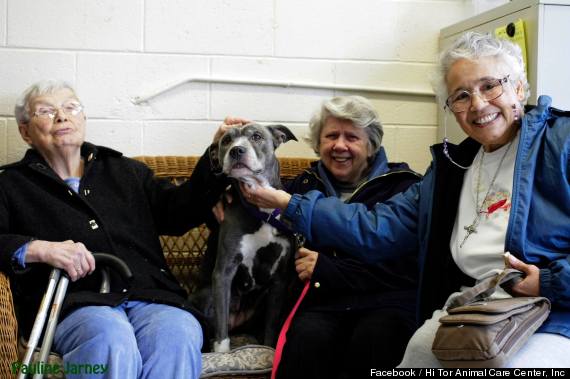
Nuns Adopt A Senior Pit Bull 'Because Nobody Else Is Going To Want Her'


On Sunday, three nuns from Pomona, N.Y., walked into Hi Tor Animal Care Center with one intention: to adopt a dog that no one else wanted.

When the women met Remy, a 9-year-old pit bull who'd been at the shelter since October, they knew she was the animal for them.

"I wanted to bring a dog home that might get euthanized if we didn't take her," Sister Veronica Mendez told News 12. "And when I noticed the sign said '9 years,' I said, 'Virginia, we want this one, because nobody else is going to want her.'"

West Artope, executive director at Hi Tor, told The Huffington Post that he was surprised that the nuns -- all over 70 years old -- weren't deterred by the thought of owning a pit bull.

"Most people have a pretty bad understanding of pits," Artope told HuffPost. "But Remy was sensitive to the sisters, especially to Sister Virginia, who walks with a cane. She kept up with her and was so attentive."

Remy now lives with the nuns at Sisters of Our Lady of Christian Doctrine. Artope told HuffPost that the sisters didn't have to pay for the adoption -- Pauline Jarney, a Hi Tor volunteer, and Roberta Bangs, a Hi Tor board member, were so moved by the nuns' actions that they covered the bill.

Wednesday, January 22, 2014

Richmond Shelter gives names to animals...

Richmond shelter gives names to animals — and they're anything but mundane

Richmond shelter tries to increase adoption by giving unique monikers to dogs and cats
Print
Font Size:
Default font size
Larger font size

Related Galleries

Advertisement
Posted: Tuesday, January 21, 2014 12:00 am | Updated: 10:47 am, Tue Jan 21, 2014.
What’s in a name? Maybe a future.
At least that’s what city animal officials were hoping when they christened Boompsy the pit bull-terrier mix; Flounder the cat; Evil-Lyne the Feral Puss; and countless others at Richmond Animal Care & Control.
“We have to name almost 4,400 animals a year, and we want to make them as individual as possible,” said Chuck Marchant, acting director of the city department.
Many shelters give their animals simple human names. The Richmond shelter takes a slightly different tack; workers there will OK almost any name — except the mundane.
It’s an open-admission facility, which means it takes in any and all animals, including many with no names.
And sometimes, that can make the job tough. These aren’t just the high-odds, photogenic and desirable animals; these are the literal underdogs — the tough sells.
The shelter works hard for a high live-release rate, but not every story there has a happy ending, Marchant said.
“You have to do something to have more wins every day than you have losses,” he said.
♦  ♦  ♦
Litters tend to get movie-type names, all in a theme. The Little Rascals are a perennial favorite, Marchant said.
The names come from a variety of sources: classic actors and actresses are popular, as are music-related names. (See Jackie Chan, the long-haired cat, and Suzanne Somers, the Labrador retriever mix.)
“It humanizes them, but also it pays tribute to pop culture that we love,” he said.
Others get named for animal control officers’ favorite cereals, or simply for phrases that stick with someone.
Crispix is a husky mix. Wiki Waka is a “brindle pit girl” who’s gotten “a little bit spazzier” during her time at the shelter, for example, Marchant said. She’s been there since early September.
Puns are a bonus, and cats that are feral have that fact worked into their names, such as Will Feral. (In that case, however, upon further examination, the cat turned out not to be feral.)
Field supervisor Richard Stewart was a fan of the “Hunger Games” trilogy, which inspired a lot of names. Other times, he turns to the Internet Movie Database. And then there was the series based on board games.
“It actually, I believe, brings a lot of people,” Stewart said. “It kind of catches somebody’s eye.”
They might be looking on Petfinder, an online animal search service, and see the name.
“And then they kind of fall in love with the animal, and it’ll make them come in, instead of it just being Bob or Spot,” he said.
No Known Origin – The Sequel was a shorthaired cat who simply showed up in the intake room one day. No one was sure where she came from — maybe the cleaning staff accepted her from someone and forgot to leave a note. Whatever her origin, she did find a home.
“If that’s what draws them in to get them out into warm and loving homes, we’re happy that it works,” Marchant said.
♦  ♦  ♦
It was a name that brought Forest, a black Lab-looking dog, into Brittany Schaal’s life and West End home.
Forest doesn’t believe in right turns.
That’s not to say that he disapproves of them; he just doesn’t seem to believe they exist. No matter what he’s doing, or where he’s going, he gets there by turning left.
“Every turn is a left turn — like NASCAR,” Schaal said.
A trip around the living room is a leisurely counterclockwise circle. A sharp right is actually a smartly executed reverse jug handle.
Schaal adores Forest, and his quirks, which vets think stem from some sort of a neurological condition.
When Forest was at Richmond Animal Care & Control, he was named Tilt-a-Whirl, after the well-known carnival ride. And that caught Schaal’s eye.
She’s a frequent adopter from the shelter (though some of those are just foster animals that became permanent).
Schaal has five pets: two dogs, Chloe and Forest; two cats, Maggie and Johnny; and one Dutch rabbit, Penelope.
Both dogs and both cats came from the city’s animal care and control shelter. So when Schaal saw a dog with the name Tilt-a-Whirl on his pen, she started wondering.
“There has to be a reason,” she remembers thinking. “Why is he called that?”
And so she learned about what she calls his quirks.
He drags his back feet some, but prances up front. When he gets tired, he has trouble standing up.
“He’s like a toddler learning to walk, or a deer on ice,” she said.
And he has trouble with stairs. If he misses one at the top, “you hear him coming,” she said.
And he can’t wait very long to relieve himself, so Schaal has affixed a cowbell to the door. He rings it when he has to go. The only hitch is that Schaal’s cat Johnny, who’s a bit on the hefty side, has figured out that ringing the bell makes people appear. And people, of course, are the source of cat food. Now, Schaal has to listen carefully. Is it the Lab’s sedate ring or a frenzied shaking?
But even with all the dog’s little differences, Schaal adored him, and he became a part of her family.
But he did need renaming. Tilt-a-Whirl drew her interest, sure, but it wasn’t handy when she was shouting for him to come in from playing with the neighborhood kids.
Looking for something shorter, no more than one or two syllables, she landed on Forest, after Forrest Gump.
“He is just quirky, and I love it,” she said.
(804) 649-6861